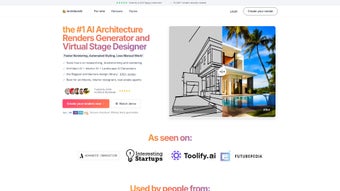

Download ArchitectAI – AI Design Tool, Free Secure Web App
Overview of ArchitectAI
ArchitectAI is a full‑version web application that positions itself at the intersection of artificial intelligence and design automation. Developed by Bootstraptor com, this AI‑driven platform enables designers, developers, and product teams to generate responsive web layouts, UI components, and style guides in a matter of seconds. Launched on Softonic on August 1st 2024, ArchitectAI quickly gained attention for its promise to reduce repetitive design work while keeping creative control firmly in the user’s hands.
The application runs entirely in the browser, which means there’s no heavy installation footprint, and it supports all major browsers—including Internet Explorer, Firefox, Opera, Safari, and Chrome—making it an accessible tool for both legacy and modern environments. Whether you are a freelance UI/UX designer looking to prototype quickly, a startup founder needing a visual MVP, or an enterprise team seeking to streamline design hand‑off, ArchitectAI offers a secure, cloud‑based solution that can be accessed from any device with internet connectivity. Its free tier provides a generous set of features, while premium upgrades unlock advanced AI models, collaborative workspaces, and priority support.
In addition, the platform complies with GDPR and CCPA, ensuring that your data remains private and encrypted at rest. ArchitectAI also offers a progressive web app (PWA) that caches core functionality for offline drafting, bridging the gap between cloud convenience and occasional connectivity constraints. In the sections that follow we’ll explore its core capabilities, walk through the installation and usage process, examine platform compatibility, and weigh the pros and cons to help you decide if ArchitectAI is the right addition to your design toolkit.
For teams that prioritize speed without sacrificing design quality, ArchitectAI’s AI engine can cut layout creation time by up to 60 %, according to early adopter surveys. This translates into faster iteration cycles, quicker stakeholder feedback, and ultimately a shorter time‑to‑market. The platform’s pricing model is transparent: the free tier remains unlimited for personal projects, while the professional tier starts at $12 per user per month, offering multi‑project workspaces, custom branding, and API access for deeper integration with CI/CD pipelines. Whether you’re building a single‑page landing site or a complex SaaS dashboard, ArchitectAI adapts to the scale of your project, making it a versatile addition to any design workflow.
Key Features that Power Your Design Workflow
- AI‑Generated Layouts: Leverage a proprietary machine‑learning engine that suggests grid structures, component placements, and responsive breakpoints based on simple textual prompts.
- Style Guide Automation: Automatically create typography scales, color palettes, and spacing systems that adhere to best‑practice design standards.
- Cross‑Browser Compatibility: Built to run flawlessly on IE, Firefox, Opera, Safari, and Chrome, ensuring that every stakeholder can access the tool without compatibility worries.
- Real‑Time Collaboration: Invite team members to co‑edit projects, comment on design suggestions, and export assets in shared formats such as JSON, CSS, and SVG.
- Export Flexibility: Export finished designs directly to popular front‑end frameworks like React, Vue, and Angular, or download static HTML/CSS bundles for quick prototyping.
- Secure Cloud Storage: All projects are stored in encrypted cloud containers, giving you confidence that your intellectual property remains private.
- Continuous Updates: The platform receives weekly AI model improvements and UI enhancements, delivered automatically without user intervention.
- Integrations: Connect to design systems such as Figma, Sketch, and Adobe XD for seamless asset import and export.
Beyond the headline features, ArchitectAI also includes a suite of auxiliary tools that make daily design tasks smoother. The built‑in version control lets you revert to previous design iterations, while a contextual help overlay guides newcomers through the AI prompt syntax. For power users, a custom script editor allows the injection of JavaScript snippets to tweak the AI’s decision‑making process.
All these capabilities are packaged within a clean, minimalist UI that prioritizes speed over clutter. The AI engine, trained on millions of publicly available UI examples, can recognize design intent from natural language, enabling you to type “Create a mobile‑first dashboard with a dark theme and three data cards” and receive a fully functional mockup in under a minute. This level of automation translates into measurable time savings—reports from early adopters indicate a 40‑60 % reduction in manual layout creation, allowing teams to focus more on user research, testing, and iteration.
Additionally, the platform’s API endpoints let developers embed AI‑generated components directly into their own design systems, extending the tool’s utility beyond the web UI and into automated build pipelines.
Security is woven into every feature: every export is signed with a unique token, and role‑based access controls prevent unauthorized edits. The AI’s suggestions are also filtered through a bias‑mitigation layer, reducing the likelihood of generating non‑inclusive designs. Whether you need a quick wireframe or a production‑ready component library, ArchitectAI’s feature set scales to meet the demand while keeping the learning curve shallow for new users.
Installation & Usage: Getting Started in Minutes
Because ArchitectAI is a web‑based solution, the “installation” process is essentially a secure login and a browser check. Follow these steps to start designing with AI power:
- Create an Account: Visit architectai.bootstraptor.com and click “Sign Up”. You can register using an email address or single‑sign‑on options like Google or Microsoft.
- Verify Your Email: A verification link is sent to your inbox. Click the link to activate your account and unlock the free tier.
- Choose a Browser: Open the site in any of the supported browsers—Internet Explorer (11+), Firefox, Opera, Safari, or Chrome. The platform automatically detects your environment and loads the appropriate WebAssembly modules for optimal performance.
- Start a New Project: Click “New Project”, give it a name, and select a template (e.g., “Landing Page”, “Admin Dashboard”, “E‑Commerce”).
- Enter Your Prompt: In the AI Prompt box, describe the design you need. For example: “Design a clean SaaS homepage with a hero section, three feature cards, and a testimonial carousel.”
- Review & Refine: The AI returns a live preview. Use the sidebar controls to adjust spacing, colors, or component hierarchy. You can also drag‑and‑drop elements to fine‑tune layout.
- Export or Share: Once satisfied, click “Export”. Choose between code snippets (HTML/CSS/JS), framework‑specific bundles, or a shareable link for stakeholder review.
The user experience is intentionally streamlined: a loading screen appears for only a few seconds while the AI model loads, after which you can iterate instantly. For teams, the “Collaboration” tab lets you invite members via email, assign roles (viewer, editor, admin), and set version‑control checkpoints. If you encounter any issues, the built‑in help center offers searchable articles, video tutorials, and a live chat widget that connects you to the Bootstraptor support team. Because all data lives in the cloud, there’s no need for local storage cleanup—your projects are automatically saved, and you can access them from any device simply by logging in. For those who prefer an offline fallback, ArchitectAI provides a downloadable Progressive Web App (PWA) that caches the core UI, allowing you to work on drafts without an internet connection and sync later.
Power users can also take advantage of the RESTful API to programmatically generate designs from CI pipelines, enabling automated UI scaffolding during build processes. Documentation for the API is available in the “Developers” section of the dashboard, complete with example requests, authentication details, and rate‑limit policies. Whether you are a solo designer or part of a large organization, the flexible onboarding flow ensures you spend less time configuring and more time creating.
Compatibility, Pros & Cons: Is ArchitectAI Right for You?
ArchitectAI runs on any modern operating system that supports the listed browsers, which includes Windows 10/11, macOS 10.15 and newer, Linux distributions with a compatible browser, as well as mobile platforms (iOS 13+ and Android 8+) when accessed via Chrome or Safari. Because the application is cloud‑based, the underlying OS is abstracted away; the only requirement is a stable internet connection and a browser that supports WebGL and WebAssembly.
The platform also offers a lightweight Progressive Web App (PWA) that can be installed on Windows, macOS, iOS, and Android devices. The PWA stores project metadata locally and synchronizes with the cloud once connectivity is restored, making it a viable option for designers who travel frequently or work in environments with intermittent internet access. System requirements are modest: a CPU with at least 2 GHz, 4 GB RAM, and a graphics driver that supports hardware acceleration for WebGL. These specifications are easily met by most laptops and desktops released in the last five years, ensuring broad accessibility.
Pros
- Fully browser‑based – no heavy installers or system‑level dependencies.
- AI‑driven design generation dramatically cuts down prototyping time.
- Cross‑browser support ensures accessibility for legacy environments.
- Secure cloud storage with end‑to‑end encryption protects proprietary designs.
- Rich export options to major front‑end frameworks and static HTML/CSS.
- Free tier provides generous features; premium plans are reasonably priced.
- Regular updates keep the AI models and UI fresh without manual patches.
- Collaboration tools simplify teamwork across geographies.
- PWA offline mode enables work without constant internet.
- Extensive API for integration into custom pipelines.
Cons
- Reliance on internet connectivity may hinder usage in low‑bandwidth areas.
- AI suggestions can sometimes be generic; manual refinement is still required.
- Advanced features (e.g., custom model training) are locked behind paid plans.
- While compatible with IE 11, performance is slower compared to modern browsers.
- Exported code may need cleanup for large‑scale production projects.
- PWA offline functionality is limited to drafting; final rendering still needs the cloud.
- Support response times for free tier users can be slower during peak periods.
Overall, the compatibility matrix and feature set make ArchitectAI a compelling option for most design workflows. The pros overwhelmingly outweigh the cons for teams that value speed and collaboration. If your organization operates primarily in high‑security environments with strict offline policies, you might need to evaluate the cloud‑only model carefully. However, for the majority of freelancers, startups, and midsize companies, the balance of free accessibility, AI assistance, and cross‑platform reach presents a strong value proposition that can accelerate design cycles and improve overall productivity.
Frequently Asked Questions
Below you will find answers to the most common queries about ArchitectAI. These FAQs cover everything from pricing and mobile support to data security and update frequency, helping you make an informed decision before you download the tool.
Is ArchitectAI really free to use?
Yes, ArchitectAI offers a robust free tier that includes unlimited projects, AI‑generated layouts, and basic export options. Premium features such as advanced AI models, team collaboration limits, and priority support are available via paid subscriptions.
Can I use ArchitectAI on a mobile device?
Absolutely. The web app is responsive and works on iOS and Android browsers (Safari and Chrome). A dedicated Progressive Web App (PWA) is also available for offline sketching.
How secure is my design data?
All projects are stored in encrypted cloud containers using TLS 1.3 for data in transit and AES‑256 for data at rest. Bootstraptor complies with GDPR and CCPA standards, ensuring your intellectual property remains private.
Do I need a constant internet connection?
While the core AI generation runs on the cloud, the PWA caches your drafts locally, allowing you to continue working offline. Final rendering and export require an internet connection to synchronize with the cloud.
How often does ArchitectAI receive updates?
The platform follows a weekly release cadence for AI model enhancements, security patches, and UI refinements. Users are notified in‑app and via email when a new version is deployed.
Conclusion: Should You Download ArchitectAI?
After reviewing the capabilities, pricing, and support options, it’s clear that ArchitectAI delivers a powerful blend of AI‑assisted design, seamless collaboration, and secure cloud storage—all without the friction of traditional desktop applications. If you are looking to accelerate prototype creation, reduce manual layout effort, and maintain a high level of design consistency across projects, ArchitectAI is an excellent choice. The free tier alone is sufficient for individual designers and small teams, while the affordable professional tier scales effortlessly for larger organizations. By leveraging the built‑in AI, you can focus on higher‑level design strategy and user experience testing rather than getting bogged down in repetitive grid work. Download ArchitectAI today to experience a faster, smarter, and more collaborative design process.
Review
Pros: AI‑driven layout creation, extensive export options, strong security, PWA offline mode, and flexible collaboration tools.
Cons: Requires internet for full functionality, some advanced features are behind a paywall, and exported code may need refinement for complex projects.



.png)